


Page 81 - Reader's HouseMagazine - Issue 62
P. 81
     Sun You’s
art offers a compelling meditation
on themes of impermanence, interdependence play, bringing together the
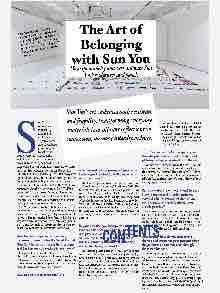
For my show at Sardine in 2018, I created multi-panel paintings that are stacked on top of each other, with sculptural pieces inserted between the paintings. Both elements reflect a playful language reminiscent of
Several artists have inspired you. How do you think your artistic style and philosophy align or contrast with theirs?
I admire many artists, including B. Wurtz—we both use humble materials, embracing a slow, sublime suc- cinct approach to gesture. I also admire Polly Apfelba- um, as we both are interested in creating provisional tableaus that celebrate women’s work, history of craft the language of abstraction.
Can you elaborate on your thoughts about impermanence and interdependence, especially in the context of the current social climate and how it informs your artistic practice?
Impermanence and interdependence aren’t ideas to me—they’re facts. As a person, I try to embrace this and, as an artist, to materialize it. Some of the ways I do this include sculptures that are held together in pre- carious arrangements using magnets and gravity. Each time they’re displayed, they shift and change.
As a curator, how do you choose the themes and artists for your projects what do you hope to communicate through these exhibitions?
My curatorial projects are often an extension of my interests as an artist and individual. These inclu- de themes such as artist migration and gentrification, feminism, physical flexibility in sculpture, intergenera- tional inspiration among artists more. These shows and events have been essential in fostering conversations and relationships that continue to shape my growth as an artist and educator. My goal is to bring people together,expandconnectionsbRueiladdcoemr’msuHniotyutsheroIuIg8h1 artist-initiated exhibitions, projects curatorial opportu- nities.
 deeply personal with the univer-
sally relatable. Born in Seoul and
based in New York, You has built an
impressive body of work that transforms everyday materials like polymer clay and cardboard into intricate sculptures and wall pieces. Her thoughtful approach celebrates the beauty of fragility, creating pieces that evoke both lightness and resilience. Recognized with accolades such as the 2023 Con- temporary Visual Art Award from the AHL Foun- dation, You’s impact extends beyond her art. As
arrangement in your process of packing art for transport contribute to the meaning of your sculptures?
My floor sculptures, made from polymer clay and cardboard boxes, have been exhibited since 2021. The form of these sculptures arises from a process in my work. I bake clay pieces in the kitchen oven and pack them in boxes to move to the studio. The arrangement of the clay is based on function: I organize them so they won’t shift or break in transit. Whereas the paintings are composed with concerns like balance or movement, the compositions in the boxes come from a place of caretaking. There is a directness to this that I want to celebrate.
In your practice, you incorporate materials that are often associated with childhood and play, such as polymer clay. How do you see the relationship between these materials and the themes of domesticity and nostalgia in your work?
My abstract panels function as both paintings and wall reliefs. These works are made with polymer clay, acrylic paint wood. Polymer clay, one of my primary materials, is typically used in crafts such as bead ma- king and children’s play. The association with domes- ticity and baking in my work is reinforced through hand-building techniques, including rolling, pinching firing clay in my home oven.
a professor, curator director of President Clinton Projects, she is dedicated to fostering collaborative and supportive communities for artists.
Sun You discusses how her life between Seoul, Det- roit New York has shaped her art, revealing the intimate themes of domesticity, nostalgia adaptation woven into her work. Her perspective brings fresh insight into the way movement, memory creative spontaneity guide her artistic practice, inviting viewers to reflect on their own experiences of home, transformation connection.
How has your experience of moving between different cities like Seoul, Detroit New York influenced your artistic process and the themes you explore in your work?
In my life, I have moved and traveled a lot. This flu- idity and impermanence have influenced how I think and create. I prioritize flexibility and lightness. My work does not require fixed production sites, as it can be easily packed and made spontaneously.
How does the idea of function and
children’s play.
The Art of
Belonging
with Sun You
H ow spontaneity and care animate Sun You’s sculptures and panels
S un You’s art embraces both resilience and fragility, transforming everyday materials into vibrant reflections on connection, memory interdependence.
Sun You explores themes of impermanence, domesticity nos- talgia, using humble materials in her art. She discusses how move- ment between cultures shapes her creative process and curatorial projects.
D


