


Page 20 - Reader's HouseMagazine - Issue 62
P. 20
 20 II Reader’s House
LITERATURE
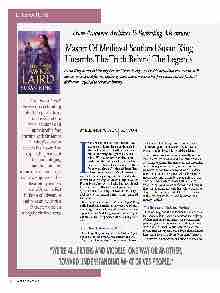
   “The Hawk Laird” weaves an enchanting tale of prophecy, love, and redemption. Isobel’s visions and unpredictable fate entwine with Sir James Lindsay’s quest to redeem his honor. The captivating blend of historical intrigue, romance, and the allure of Scotland keeps readers engrossed. This beautifully written novel offers a perfect balance of adventure and passion, with rich characters and an unforgettable love story.
IBY ELEANOR WILSON LONDON
From Academic Archives T o Bestselling Adventures
Master Of Medieval Scotland Susan King Unearths The Truth Behind The Legends
Susan King discusses blending her art history background with meticulous research to craft authentic medieval fiction, exploring the nuances between her pen names and the physical dedication required to resurrect history.
n the realm of historical fiction, few authors navigate the mist-shrouded glens of medieval Scotland with as much authority and grace as Susan King. With a career spanning over thirty novels and novellas, King has established herself as a master of the “historical thread”—that delicate line where meticulous academic research
and medieval studies provided more than just a chronological framework; they offered a sensory methodology for world-building.
“Art history taught me to be visually obser- vant, a creative thinker, and a careful research- er,” King explains. She notes that the discipline of art history is, at its core, an exercise in narrative. Much like a novelist, an art historian must construct an argument with a beginning, middle, and end, using deep research to evoke emotion and character from a static object. When King transitioned to fiction, she brought this “visual thinking” with her, allowing her to describe the tactile world of the 11th century with a clarity that feels lived-in rather than merely studied.
The Balance of Fact and Feeling
One of the greatest challenges for any histor- ical novelist is the tension between the rigidity of facts and the requirements of a compelling plot. King views this not as a conflict, but as a difference in intent. While nonfiction writers reconstruct history through a logical, analytical lens, King sees her role as “conjuring” history.
“A writer in nonfiction or fiction becomes an
meets the soaring imagination of a storytell- er. Whether writing as Susan King or Susan Fraser King, her work, including acclaimed titles like Lady Macbeth and Queen Here- after, serves as a bridge between the dusty archives of the past and the vibrant pulse of the present.
In a recent interview for Mosaic Digest, King pulled back the curtain on her creative process, revealing how a background in art history and a penchant for “catching arrows” have shaped one of the most respected voices in the genre today.
From the Gallery to the Page
For King, the journey into the Middle Ages began not in the library, but through the eye of an artist. Her academic roots in art history
“WE’RE ALL FILTERS AND MODELS, ONE WAY OR ANOTHER, TOWARD UNDERSTANDING WHAT DRIVES PEOPLE.”


