


Page 38 - Reader's HouseMagazine - Issue 62
P. 38
BEHIND THE BESTSELLER
A visionary architect of imagination, Marie Lu mas- terfully weaves raw human emotion into cinematic worlds, defining a generation of literature.
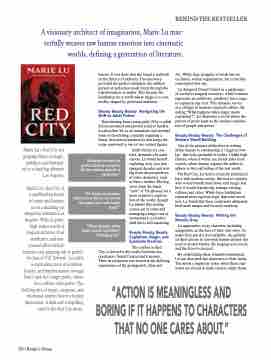
 Marie Lu’s Red City is a gripping blend of magic, ambition, and betrayal, set in a dazzling alternate Los Angeles.
Marie Lu’s Red City is a spellbinding fusion of crime and fantasy,
set in a dazzling yet dangerous alternate Los Angeles. With its gritty,
high-stakes world of magical alchemy, rival syndicates, and star- crossed allies-turned-
enemies, this gripping tale is perfect for fans of V.E. Schwab. Lu crafts a captivating story of ambition, loyalty, and transformation through Sam’s and Ari’s tragic paths, where love collides with power. The thrilling mix of magic, suspense, and emotional conflict leaves a lasting impression. A dark and compelling start to the Red City series.
Ari. While Sam struggles to break into an exclusive, walled organization, Ari is forcibly conscripted into one.
Lu designed Grand Central as a gatekeeper of exclusive magical resources, while Lumines represents an ambitious, predatory force eager to expand at any cost. This dynamic serves
as a critique of modern corporate culture. By asking “What happens when magic meets capitalism?”, Lu illustrates a world where the pursuit of profit leads to the careless exploita- tion of people and power.
Beauty Beauty Beauty The Challenges of Modern World-Building
One of the primary difficulties in writing urban fantasy is constructing a “magical over- lay” that feels grounded in reality. Unlike high fantasy, where a writer can invent rules from scratch, urban fantasy requires the author to adhere to the scaffolding of the real world.
For Red City, Lu had to reconcile alchemical laws with modern society. She had to consider who would benefit most from such magic and how it would realistically reshape existing cultures and cities. While these limitations required more rigorous logic than total inven- tion, Lu found that these constraints ultimately bred more unique and focused creativity.
Beauty Beauty Beauty Writing the Morally Grey
Lu approaches every character, including antagonists, as the hero of their own story. To make Sam and Ari feel authentic, she ground- ed their actions in universal human desires: the need to protect family, the longing to be loved, and the drive to succeed.
By establishing these relatable foundations, Lu can then push her characters to their limits. The moral complexity arises when these char- acters are forced to make choices under threat
“ACTION IS MEANINGLESS AND BORING IF IT HAPPENS TO CHARACTERS THAT NO ONE CARES ABOUT.”
braries. It was there that she found a textbook on the history of alchemy. The discovery provided the perfect metaphor: the ruthless pursuit of perfection made literal through the transformation of matter. This became the foundation for a world where magic is a com- modity shaped by greed and ambition.
Beauty Beauty Beauty Navigating the Shift to Adult Fiction
Transitioning from young adult (YA) to adult fiction presented unexpected creative hurdles. Lu describes YA as an immediate and intimate form of storytelling, typically requiring a linear, first-person perspective that keeps the scope narrowed to one or two central figures.
Adult fiction, by con- trast, demands a broader canvas. Lu found herself exploring story arcs that spanned decades and writ- ing from the perspectives of older characters, such as Sam’s mother. Moving away from the linear “now” of YA allowed for a more expansive explora- tion of the world, though Lu admits that writing scenes out of order and managing a larger cast of viewpoints is a creative shift she is still mastering.
Beauty Beauty Beauty Capitalism, Magic, and Syndicate Rivalries
  38 II Reader’s House
"Alchemy became the perfect fantasy metaphor for the ruthless pursuit of perfection."
 "YA fiction is intimate; adult fiction allows for stories that span years with larger scope."
 "What happens when magic meets capitalism? Nothing good."
The conflict in Red City is driven by the rivalry between two
syndicates: Grand Central and Lumines. Their development was rooted in the differing experiences of the protagonists, Sam and


